
Thank you for downloading!
Subscribe to our newsletter to receive email updates about our work, get connected and support Australians impacted by eczema. You can unsubscribe at any time.
Subscribe Now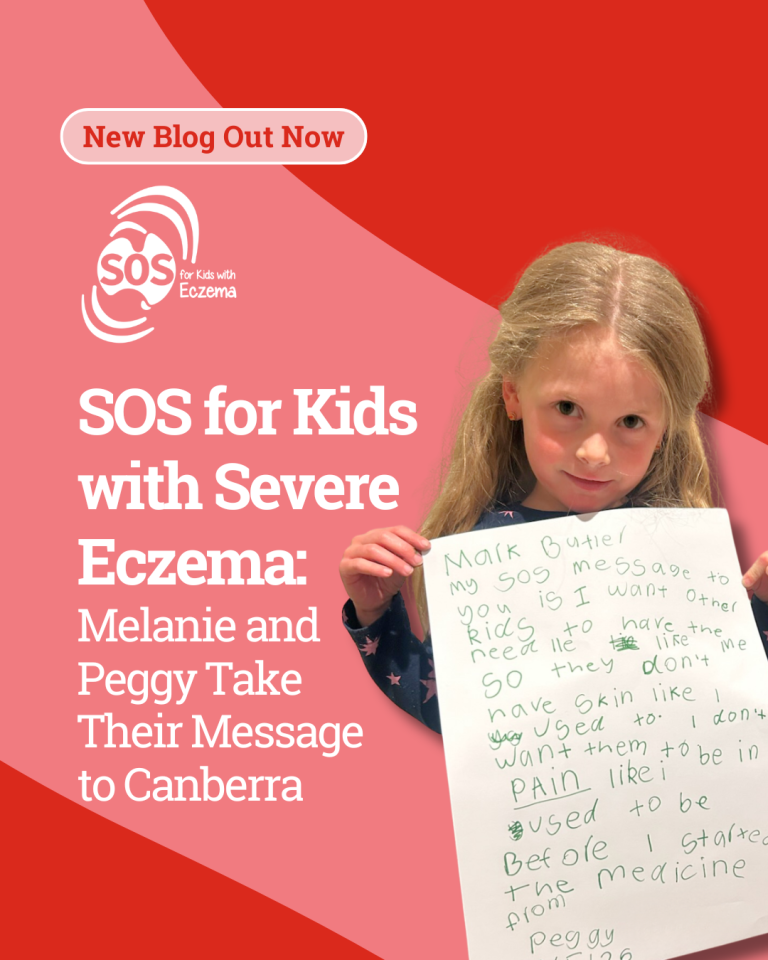
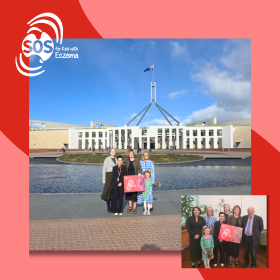 Last week, Eczema Support Australia’s Founder and Managing Director, Melanie Funk, visited Canberra to advocate for children living with severe eczema and their families.
Melanie was joined by Paediatric Dermatologist A/Prof Li-Chuen Wong, Caroline Zoers from the Australasian College of Dermatologists, Rachel, and six-year-old Peggy as they met face to face with Federal Government decision-makers about the SOS for Kids with Severe Eczema campaign.
The SOS campaign has helped raise awareness of the daily reality of living with severe eczema and the urgent need for better access to treatment and support for children affected by this chronic condition.
Importantly, the campaign has also given families across Australia a way to share their stories, speak up, and have their voices heard.
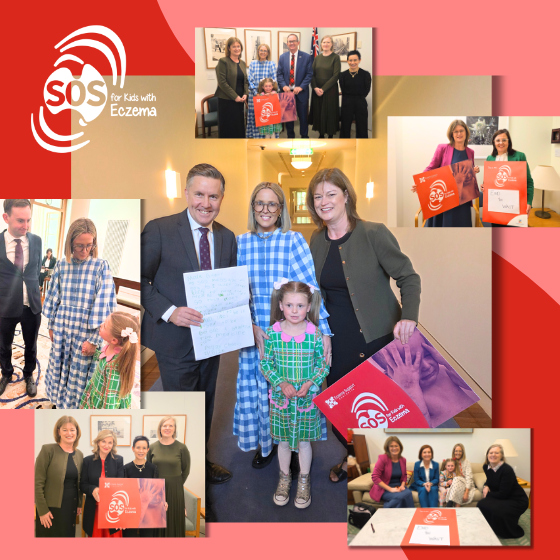
The meetings in Canberra were an important opportunity to remind decision-makers that behind every policy discussion, there are real children, real parents and real lives.
The group met with the Hon. Mark Butler MP, Minister for Health and Ageing, as well as key Senators and Members of Parliament from electorates across the country.
The message to Minister Butler and his colleagues was simple and urgent:
Children with severe eczema should not carry the burden of unresolved pricing negotiations between Government and pharmaceutical companies.
Eczema Support Australia acknowledges that listing medicines on the Pharmaceutical Benefits Scheme, also known as the PBS, is a complex process. However, while these processes continue, children and families are living with the daily consequences of delay.
Dr Wong shared the clinical reality and treatment gap for children under 12 living with severe eczema.
Access to newer targeted eczema treatments remains a major issue for many families, despite some children already waiting years for equitable and affordable access to treatment options that may significantly improve symptoms, quality of life and long-term outcomes.
She also shared that emerging Australian real-world evidence is showing major improvements for children receiving newer treatments, including better symptom control, disease modification, improved quality of life and reduced hospital burden.
Clinicians are seeing the transformational impact these treatments can have for some children and families.
When severe eczema is better controlled earlier, it has the potential to change the trajectory of the disease. It can help children sleep, learn, play, connect and live more comfortably. It can ease pressure on parents and carers, and may also help reduce the burden on hospitals and the broader healthcare system.
Caroline Zoers provided valuable insights into workforce challenges and broader system pressures, particularly the difficulties many families face when trying to access specialist care.
Long waiting times to see dermatologists and specialists remain common, especially outside major metropolitan areas. For many families, access to care can depend heavily on where they live, what they can afford and their ability to navigate an already stretched healthcare system.
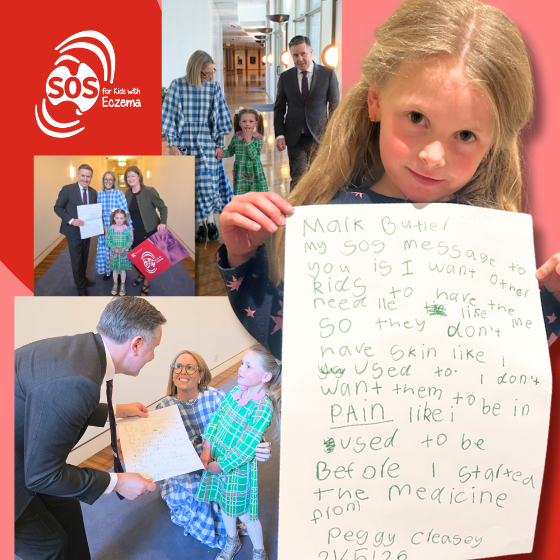
But it was six-year-old Peggy’s sincere and simple message that truly rang out:
“I don’t want them to be in pain.”
Her words reminded federal decision-makers that severe eczema is not just about numbers, processes or policy discussions.
It is about people.
It is about children and families living with pain, sleepless nights, flare-ups, appointments, treatments and uncertainty every single day.
Peggy’s message captured what statistics alone cannot!
Melanie spoke about the need to recognise eczema as a long-neglected chronic disease in Australia.
Almost three million Australians are impacted by eczema, yet the burden carried by children and families is still too often overlooked.
Severe eczema can affect mental health, sleep, school attendance, work, family routines, healthcare use and household finances. For children living with severe eczema, the impact can reach into every part of daily life.
The next major milestone is the meeting of the Pharmaceutical Benefits Advisory Committee, known as the PBAC, from 8–10 July.
At this meeting, the PBAC will consider whether dupilumab should be funded through the PBS for young children living with severe eczema.
The outcome of this review is expected to be published on the Department of Health website on Friday, 21 August.
It is important to understand that a positive PBAC recommendation does not mean a PBS listing comes into effect immediately. After a positive PBAC funding recommendation, the company responsible for the medicine and the Department of Health must negotiate a formal agreement for PBS listing.
While this process can take several months, Eczema Support Australia remains hopeful that children with severe eczema may have access to a PBS listing before the end of the year.
As the SOS for Kids with Severe Eczema campaign was taken to Canberra, Eczema Support Australia reaffirmed its commitment to advocating for a fairer and more recognised future.
We will continue to advocate for a future where Australians better understand the true impact of eczema, and where access to treatment is achievable, equitable and affordable for children and families across the country.
Click here to read our leave-behind document for parliamentarians.
Subscribe to our newsletter to receive email updates about our work, get connected and support Australians impacted by eczema. You can unsubscribe at any time.
Subscribe Now