


Thank you for downloading!
Subscribe to our newsletter to receive email updates about our work, get connected and support Australians impacted by eczema. You can unsubscribe at any time.
Subscribe Now
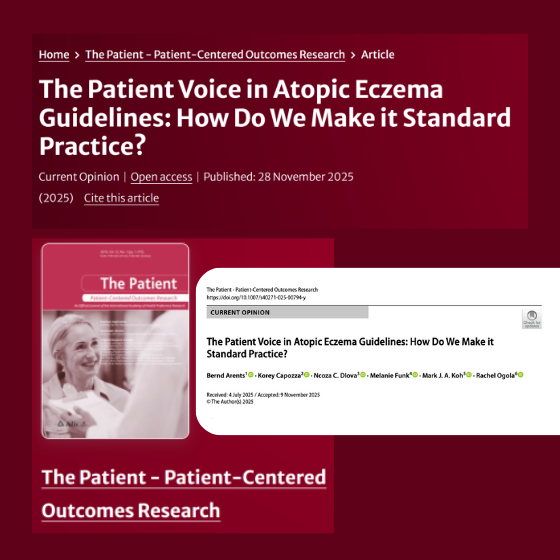
Eczema Support Australia is proud to share that Managing Director, Melanie Funk, is a co-author and the corresponding author on a new open access article, “The Patient Voice in Atopic Eczema Guidelines: How Do We Make It Standard Practice?” This international project was initiated and coordinated by the International Alliance of Dermatology Patient Organizations (GlobalSkin), and brings together patient leaders and clinical experts from around the world to make the case for meaningful patient involvement in atopic eczema guidelines.
Atopic eczema is a chronic inflammatory skin condition that can affect almost every aspect of life, including sleep, work and study, family life, mental health, and participation in everyday activities. Despite this, most existing eczema guidelines still do not include the perspectives of the people and families who actually live with the condition.
The new article highlights that when patients and caregivers are part of guideline development, they bring essential insights about what really matters in care – such as preventing flares, managing treatment burden, and addressing the psychological and social impact of eczema, rather than focusing solely on the appearance of the skin.
This work was initiated by GlobalSkin and co-authored by:
The collaboration brings together perspectives from different regions, health systems and communities to explore how patient and caregiver voices can be embedded as standard practice in eczema guideline development and implementation.
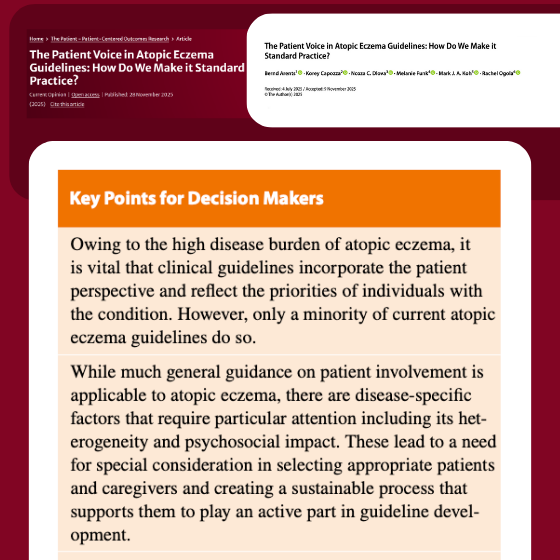
The work outlines several practical actions to support sustainable patient involvement, including:
These steps align closely with Eczema Support Australia’s advocacy for shared decision making, evidence-based care and equitable access to treatments and support.
Being part of this article allows Eczema Support Australia to:
We will be using the findings from this work to inform our engagement with guideline developers, policymakers and professional bodies in Australia.
The article is open access and available here:
If you are a clinician or policymaker interested in working with Eczema Support Australia on guideline or policy development, please contact melanie.funk@eczemasupport.org.au
Use our Eczema Care Online Toolkit to find out the best way to care for your eczema or your child's eczema.
Subscribe to our newsletter to receive email updates about our work, get connected and support Australians impacted by eczema. You can unsubscribe at any time.
Subscribe Now